The Legal AI Value Stack: Five Levels of Defensibility

After Anthropic’s legal plugin triggered a $285B selloff, everyone’s asking which legal AI companies will survive. I think that’s the wrong question.
I tested Claude’s legal plugin the day it came out. As a lawyer, I was impressed. But what stuck with me wasn’t the plugin itself. It was what it represented: a foundation model doing, out of the box, what dozens of legal AI startups have been building toward for years.
And the plugin was just the beginning. Within weeks, Anthropic released Claude Cowork on Windows, reaching roughly 70% of the desktop market, with full MCP support. Companies like Midpage have already built MCP connectors that give Claude direct access to real case law databases and citators.
The barrier to entry for legal AI isn’t slowly declining. It’s collapsing.
Over the past six months, I’ve hosted six closed-door roundtables with legal teams — three in Silicon Valley, three across Beijing, Shanghai, and Hong Kong. Talking to GCs, partners, founders, and young lawyers across the two largest legal markets in the world, I kept hearing variations of the same question: where does defensibility actually live now?
What follows is the framework that emerged from those conversations. I call it the Legal AI Value Stack: five levels of defensibility, each with very different staying power.
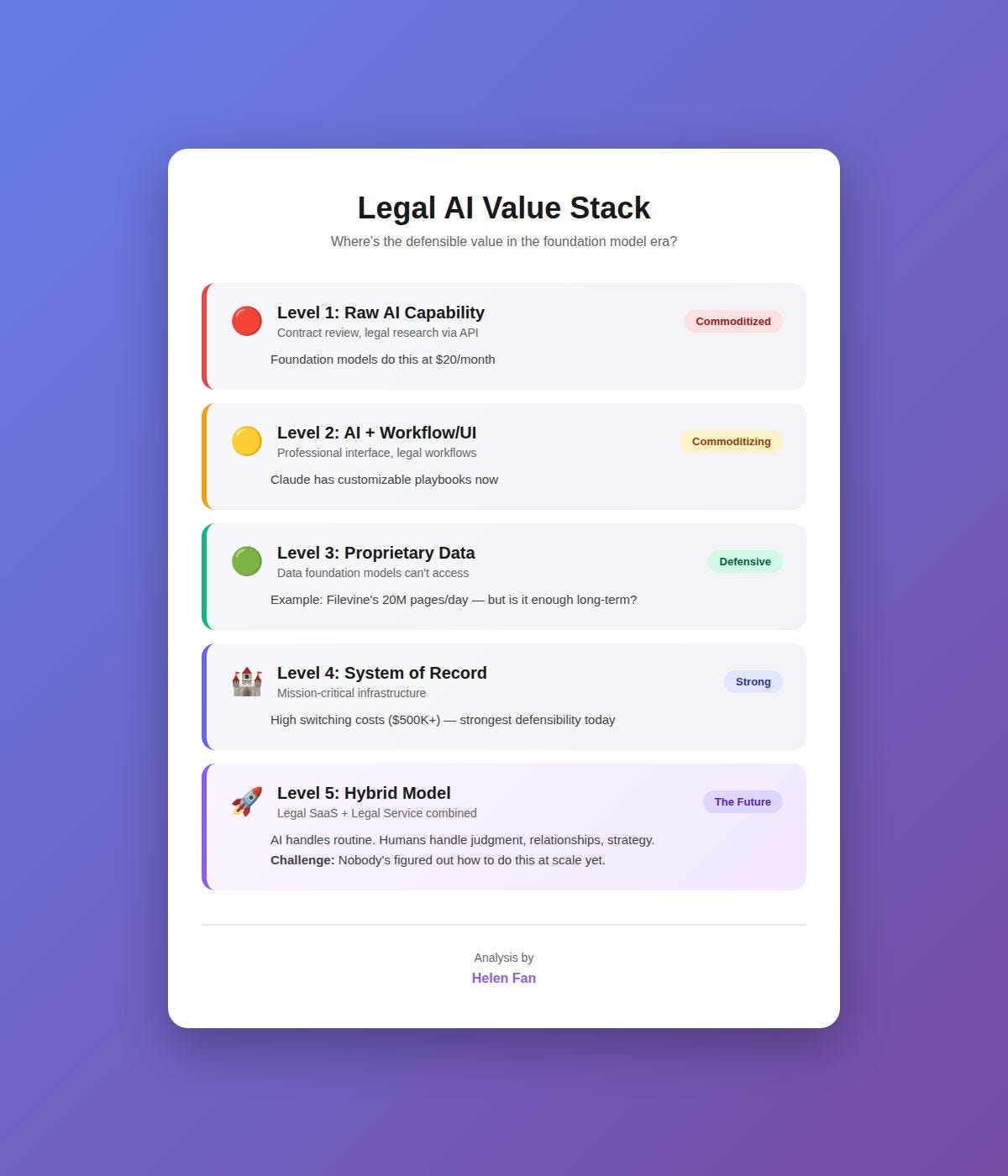
Level 1: Raw AI Capability
What it looks like: Essentially, this is a chat interface powered by foundation model API calls — some with a RAG layer on top, many without. The most common use cases: contract review and legal research.
Status: Already commoditized.
These products have little to do with how lawyers actually work. There’s no workflow integration, no connection to the systems lawyers live in day-to-day. Pricing is all over the place — mostly a function of how aggressive the marketing is, not how much value the product delivers.
Anthropic’s legal plugin dramatically compressed this layer’s economics. Compliance-grade providers with authoritative data sources, citation traceability, and audit trails still have a role — but when a foundation model can do 80% of what a Level 1 product does for free, the pricing pressure is brutal. The moat was always shallow: prompt engineering is replicable, and foundation models improve faster than any wrapper can differentiate.
Level 2: AI + Workflow
What it looks like: Professional interfaces, legal-specific workflows, structured outputs, customizable playbooks. A typical example: the wave of Word add-ins that bring AI-powered redlining and contract analysis directly into the document where lawyers already spend their time.
Status: Commoditizing now.
This was supposed to be the defensible layer. “Sure, anyone can call the API, but we’ve built the workflow lawyers actually need.” The problem? Claude’s legal plugin already ships with customizable playbooks, structured outputs, and a professional interface. The gap between “raw API” and “polished legal product” is closing faster than most founders expected.
Investors are noticing. The story of “we built a better UI on top of GPT” doesn’t excite the way it did in 2024.
Level 3: Proprietary Data
What it looks like: Companies whose platforms get smarter the more clients use them — accumulating negotiation patterns, clause preferences, risk signals, and workflow behaviors that no foundation model has access to.
Status: Real defensibility today — but more of a transitional layer than a permanent moat.
When people hear “proprietary data” in legal tech, they often think of companies like Thomson Reuters and LexisNexis — decades of aggregated case law, editorial layers, and citator systems. That’s a real asset, but it’s built on public data, and as standards like MCP mature, the access barrier is narrowing. Access to data is not the same as ownership of data, so this advantage won’t vanish overnight — but the differentiation space shrinks.
The kind of proprietary data I’m talking about at Level 3 is different. It’s generated by lawyers using the platform every day — reviewing contracts, marking up clauses, flagging risks, making judgment calls. Over time, the platform learns from this usage: which clause types trigger the most negotiation friction in a given industry, which risk flags are most predictive of deal failure, which sequence of steps works best for different types of legal questions. This is intelligence that only emerges at scale, across hundreds or thousands of clients. No single client’s usage can produce it.
This is what separates Level 3 from Level 1-2. A Level 1 product where a client uploads their own files doesn’t make the platform any smarter — next client starts from zero. At Level 3, the platform itself is learning and compounding.
Level 4: System of Record
What it looks like: Products that become so embedded in how legal teams operate day-to-day that replacing them is either deeply painful or practically unthinkable.
Status: Strongest defensibility today.
Level 4 is about becoming infrastructure. Practice management platforms like Clio and Filevine are classic examples — they’re not just AI tools, they’re the platform legal teams run their entire practice on. Years of case data, client records, billing history, and team workflows live inside these systems. Switching means migrating years of institutional knowledge and retraining an entire team. And once a platform starts absorbing adjacent capabilities — as Clio did by acquiring vLex’s billion-document legal research library — the gravity only increases.
The same logic applies at the enterprise level: corporate legal departments where contract systems are wired into procurement, compliance, and ERP infrastructure; law firms where AI is deeply connected to document management and financial systems. The deeper the integration, the higher the switching cost.
The moat here is built not on technology, but on operational gravity.
The Hard Truth About Levels 1–4
I want to be honest: Levels 3 and 4 are smart strategies. They buy time. Real time. But they’re what I’d call pre-AGI strategies.
Here’s why. We are heading toward a world where two things converge:
First, system consolidation. Everything that’s currently fragmented across departments — legal data, financial data, compliance records, communications — will eventually live inside unified AI systems. The walls between systems that make Level 4 integration so valuable today? Those walls are temporary.
Second, capability convergence. AI models are getting better, faster than most people in the industry expect. The moats that work today — proprietary data, system integrations, vertical workflows — work because current AI has limitations. But these are limitations of the current technology, not permanent structural advantages. They slow down commoditization. They don’t stop it.
And there’s a directional asymmetry: Level 2-3 companies face pressure from both directions — foundation models commoditizing from below, and Level 4 platforms absorbing from above. When you already own the daily workflow, adding AI features or acquiring data assets is just stacking value on an existing relationship. A Level 2 AI tool trying to become a system of record? That means convincing firms to migrate their entire practice — a much harder sell.
To be precise: this is a directional argument, not a prediction about timing. Enterprise system fragmentation isn’t just a technology problem — it’s also about permission structures, regulatory compliance, departmental budget politics, and data ownership. These frictions may slow the timeline considerably. But the direction is clear: Levels 1 through 4 are all converging toward infrastructure.
So what’s left?

Level 5: The Hybrid Model — AI + Human, Redesigned
What it looks like: Not selling software to law firms. Becoming one. Hiring lawyers, deploying AI as the operational backbone, and delivering legal services directly to end clients.
Status: Early but accelerating — fast.
This is the level I find most compelling, and it’s the one that’s moved from theoretical to real in just the past few months.
Why Level 5 survives the AGI era — and the others don’t.
If AI can eventually handle everything from research to drafting to system integration, why does Level 5 — which still requires humans — have any defensibility at all?
Because legal services, at their core, are a trust business. Legal work runs on information asymmetry — clients pay because they can’t fully evaluate the work themselves. When you can’t evaluate the work, you rely on trust. Trust in the person across the table. Trust built through tone, empathy, judgment in ambiguous situations, and the willingness to be accountable. Even in an AGI world where the AI can draft a perfect contract, someone still needs to sit with the client, navigate the politics of a deal, and take ownership when things go wrong. This is not a temporary limitation of AI. This is the nature of the service itself.
And there’s a harder edge to this: it’s not just about trust. It’s about liability. When something goes wrong — and things do go wrong — someone needs to be accountable. AI companies ship with disclaimers. Lawyers carry malpractice insurance. Clients need someone they can hold responsible. That’s a structural role that software alone cannot fill.
Who’s already doing this. The list is growing fast. Lawhive started by trying to sell automation software to small law firms — the firms didn’t want it. So they became a law firm themselves, redesigning operations with AI at the center. Result: $60M Series B, $35M ARR (7x growth in one year), 500 lawyers on the platform. Eudia, backed by $105M from General Catalyst, acquired an ALSP and launched an AI-augmented law firm under Arizona’s Alternative Business Structure framework, crossing $20M ARR. Y Combinator’s Winter 2026 batch includes multiple AI-native law firms — General Legal, Arcline, LegalOS — and its 2025 Request for Startups urged founders to “start your own law firm, staff it with AI agents, and compete with existing law firms.” Not “build better tools for lawyers.” Compete with them.
More companies are exploring this direction — some from legal tech, some from law firms themselves. The pattern is clear: the most ambitious players are no longer content to sit at Levels 1–4.
What Level 5 really means. Traditional legal AI (Levels 1–4) accepts the existing law firm model and tries to optimize it. Level 5 says: what if the model itself is the problem? What if the reason legal services are expensive, slow, and inaccessible isn’t a technology problem but an organizational one — and AI is what finally makes a different organizational model viable?
The hybrid model works because it combines the two things that matter: AI handles the routine, the repetitive, the data-heavy — everything that scales. Humans handle the trust, the accountability, the relationships — everything that doesn’t.
This is the only level where the value compounds rather than erodes. Because in a world where AI capability is a commodity, the scarce resource isn’t intelligence. It’s trust.
The Unresolved Questions
I don’t want to pretend Level 5 is a clean answer. There are real tensions nobody has fully resolved:
The pricing paradox. Clients want AI efficiency but also want to know there’s a human taking responsibility. Are they paying for software or for human judgment? Lawhive has navigated this with fixed fees, but the broader industry is still figuring it out.
The judgment question. Legal AI companies are, in some ways, the first group of people who genuinely believe AI can handle portions of legal judgment — not just research and drafting, but actual analytical decision-making. Most Big Law partners don’t think this way. Most GCs don’t either. Level 5 only works if clients trust the model.
The career structure problem. If AI handles the routine work that junior lawyers traditionally cut their teeth on, where do the next generation of senior lawyers come from? I heard this concern at nearly every roundtable I hosted. At a conference in Shanghai, a young lawyer’s post went viral: “AI helps managers delegate, track, and control better. But for those of us under 30? We’re reviewing more contracts than ever, yet our compensation and opportunities haven’t changed. Where do we grow?” Level 5 companies need an answer — not just for ethical reasons, but because their own talent pipeline depends on it.
The China factor. Something most Western observers aren’t tracking closely enough: China’s foundation model price war is far more aggressive than in the US, and public case law is highly accessible — all published court decisions are available online. The conditions that make Levels 1–3 viable in the US — fragmented data, premium pricing — simply don’t hold in the same way. If the largest legal market outside the US is moving to a world where foundation models handle routine legal work at near-zero cost, the commoditization timeline might be shorter than anyone in Silicon Valley assumes.
Where I Stand
The companies that will matter in legal AI are the ones brave enough — or desperate enough, as Lawhive was — to cross the line from selling tools to delivering services. To take on the organizational risk, the regulatory complexity, and the cultural resistance that comes with actually being a law firm, not just serving one.
Level 5 isn’t easy. Nobody’s fully figured it out at scale. But it’s the only level where the value compounds rather than erodes.
The GPT wrapper era is over. The SaaS-for-lawyers era is winding down. What comes next is messier, harder, and more interesting.
This piece maps the terrain. Next, I’m going deeper: talking to more legal tech companies, law firms, and GCs to pressure-test what the breakout strategy looks like at each level. How do Level 2 companies avoid being swallowed by foundation models? What does a credible Level 3 data moat actually require? Can Level 4 companies move fast enough to stay ahead of system consolidation? Stay tuned.
This is Part 2 of my series on structural shifts in legal tech. Part 1 explored why legal tech in China looks so different from the US. If you’re a legal professional, founder, or operator navigating these questions, I’d love to hear from you.
You can also find me on LinkedIn or book a time through my calendar assistant.